



| Quantity: | |
|---|---|
LS-2162
Transformer Turns Ratio and Winding Resistance Tester
The LS-2162 Transformer Comprehensive Testerintegrates a DC resistance tester and transformer ratiotester into one device for testing arge powertransformers.
■Product Design
1.One-time wining completes all tes items,reducing the workload of on-sitetesters.
2.Equipped with a 7-inch color touch LCD screen for control and display,providing a user-friendly interface.3.Buit-in micro printer for on-site printing of test results.
4.USB storage function for extemal storage of tes results.5.One isolated RS232 communication interface with standard protocolcommunication.
6.Bluetooth communication module with standard protoool wireless
communication.
7.High-reliability RS485 bus for intemal communicaion.8.Isolated circuit design to eliminate interference between test functions;hardware and software filtering to improve ant-interference capability;goodgounding and shielding measures to enhance overall anti-interferenceCapability.
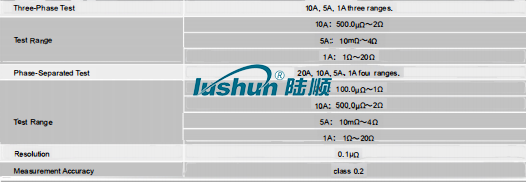
■DC Resistance Test
1.Three-phase simultaneous testing and automatc magnetization.
2.High and low voltage current and potential tes leads can be connected tothe transformer at once,eliminating the need to switch test leads during thetest
3.For star-connected windings with a neutral point,the AD.B0,and CD phaseresistances can be tested simultaneously,significantly saving test time.
4.For an internally delta-connected three-phase five-limb transformer,theautomatic excitation method can be used during low-voltage side testing,which offers fast testing speed.
5.Displays and prints all est data of high,medium,and low voltage windings.automaically calculates three-phase unbalance,and prints resistance valuesconverted to rated temperature.
6.Comprehensive back EMF protection
■Transformer Ratio Test
1.Chinese/English menu prompts,simpe and convenientoperation.
2.Three-phase testing only requires inputting the high-voltage side connectionmethod to automatically measure the group
3.Capable of both single-phase measurement and automatic testing ofthree-phase windings.The connection group can be arbitranly selectedcompleting the measurement of parameters such as the rabio,errorandconnection group of AB,BC,and CAphases in one go.4.Protection function for high and low voitage reverse connection.
5.Fasttesting speed,completing single-phase testing in 15seconds.6.Protection functions for transformer short-circuit and inter-tum short-circuit
VRP Series Varnish Removal Oil Purifier
Application
Used in gas and steam turbine, compressor, to remove dissolved and suspended soft pollutants in oil products, sludge and other harmful substances. Avoid turbine failures and expensive oil changes due to paint film problems. When the film is formed, the loss of production is very high. The initial formation of the film is known as a soft pollutant, caused by hot spots in the system, such as bearings, pumps, and high flow on-line filtration. Recent studies have found that the existence of soft pollutants can be divided into dissolved state and suspended state, by removing these soft oxides can avoid the production of paint film. Once the film forms, it will clog valves, filters and other small links, and the life of the oil will be significantly reduced.
The formation of cleaning film will cause the following adverse consequences: valve adhesion, loss of control, resulting in unit failure or startup failure; Filter plugging, limiting oil flow, resulting in oil temperature rise and wear increase; Heat exchange failure, oil temperature rise; Sandpaper surface, increase component wear; Forming paint on the bearing, limiting flow, increasing wear and temperature; Frequent oil changes and system flushes. When the soft pollutants are dissolved in the oil, typically when the oil temperature is above 40℃, they cannot be removed by ordinary mechanical filtration or electrostatic filtration, and these soft pollutants show natural magnetism. For polar absorption, the cooler metal surface "cold spot", i.e. the valve and cooler. When the temperature of the oil is lowered, the thermal stability of the soft pollutants is less than that of the oil, so they are more likely to bake hard on hot surfaces, such as axial shafts.
VRP paint film cleaner. It achieves revolutionary and efficient removal of soft pollutants (dissolved and suspended) from oil products, including gas and steam turbines and compressors under high temperature operation. The warm oil is pumped from the lowest point at the bottom of the tank to the VRP paint film purifier by the equipment's own transfer pump. After cooling treatment (using the thermal stability of the paint film is worse than that of oil), the paint film, particulate matter and moisture are removed by the filter element with wood fiber as the raw material (no need to use ion-exchange resin filter material, greatly saving the cost of use).
Features:
● Increase system reliability and stability. ● No more shutdowns and startup failures caused by paint film.
● No longer need to clean the tank and system flushing. ● Increase jacking oil pressure, more stable bearing temperature.
● Improve the life of oil products, blood additives and system components, such as bearings, valves, seals, etc.
● Great savings can be achieved by avoiding turbine failure and extending the life of oil products. Features:
● Increase system reliability and stability. ● No more shutdowns and startup failures caused by paint film.
● No longer need to clean the tank and system flushing. ● Increase jacking oil pressure, more stable bearing temperature.
● Improve the life of oil products, blood additives and system components, such as bearings, valves, seals, etc.
● Great savings can be achieved by avoiding turbine failure and extending the life of oil products.
Technical Specification
|
Model |
VRP-10 |
|
Flow |
10L/min |
|
Working Pressure |
≤0.5Mpa |
|
Total Power |
5.55KW |
|
Power Supply |
AC380V/50Hz |
|
Overall Dimension |
1466mm×1126mm×1750mm |
|
Net Weight |
500kg |
|
Particle contamination degree(NAS1638)
|
≤6grade |
|
MPC data |
<15 |
■Above size and weight of this equipment are for reference only, the specific data shall be subject to its physical object.


 渝公网安备 50010702502819号